
What's inside Good Bards' Marketing OS?

Updated: Mar 27
Marketing has entered a phase where growth is no longer limited by access to channels, tools, or content. It is limited by coordination. Over the past decade, marketing stacks expanded rapidly to solve individual problems: automation, analytics, personalisation, CRM, paid media, and content. Each tool optimised a narrow function, but few were designed to work as part of a coherent system. The result is a landscape where data is fragmented, execution is siloed, and decision-making is slowed by manual handoffs.
At the same time, customer behaviour has become harder to predict. Buying journeys are non-linear, signals are spread across channels, and timing matters more than volume. Static workflows and channel-specific optimisation can no longer keep up. This is why the concept of a Marketing OS has become necessary. Not as a replacement for creativity or strategy, but as the operating layer that connects data, decisions, and execution across the entire marketing lifecycle.
Agentic AI as the execution layer
As marketing systems become more complex, automation alone is no longer sufficient. Predefined rules can execute tasks, but they cannot decide what should happen next when conditions change.
This is where Agentic AI becomes essential. Within a Marketing OS, agentic systems act as the execution layer that continuously interprets signals, makes decisions, and coordinates actions across channels. Rather than following static instructions, agents operate with context and intent, allowing marketing to respond dynamically to real-world behaviour.
In practice, this shows up as flexible execution modes, where marketers can choose when to guide the system and when to let agents operate autonomously. This balance allows teams to retain strategic control while enabling the system to act intelligently when speed, scale, or complexity demand it.
Marketing OS as the orchestrator
A Marketing OS is the system that coordinates data, decisions, and execution across the entire marketing lifecycle. Rather than functioning as another point solution, it acts as the operating layer that governs how marketing actually works across teams, channels, and markets.
As marketing stacks have grown more complex, performance is no longer constrained by creativity or channel access. It is constrained by fragmentation. Data lives in different places, execution happens in silos, and reporting is stitched together after the fact. A Marketing OS is designed to resolve this by treating marketing as a connected system rather than a collection of tools.
Centralised Marketing Operations
At the operational level, a Marketing OS provides a single environment where marketing work is planned, coordinated, and executed. Campaigns, tasks, assets, and workflows are managed from one command centre, giving teams shared visibility into priorities and progress.
This centralisation reduces operational drag. Instead of duplicating effort across tools or relying on manual handoffs, teams can move faster with fewer breakdowns. As organisations scale across regions or product lines, centralised operations ensure that execution remains consistent without becoming rigid.
Customer Data Platform (CDP) and Master Contact List
At the foundation of a Marketing OS sits a unified customer data layer. A built-in CDP and master contact list consolidate audience data across channels, platforms, and systems into a single profile per contact.
This resolves one of marketing’s most persistent challenges: fragmented identity. Without a unified view, personalisation, attribution, and reporting all suffer. By maintaining a continuously updated master contact list, a Marketing OS ensures that every interaction is informed by the same understanding of the customer, regardless of channel or campaign.
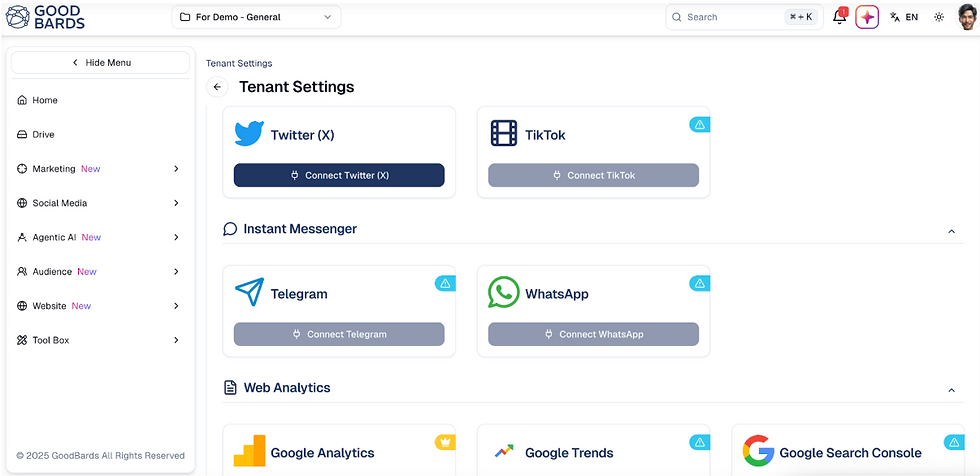
This unified data layer is made possible through direct integrations with marketing, messaging, analytics, and search platforms, ensuring that audience data flows continuously into a single system rather than remaining trapped in channel-specific silos.
Segmentation and Audience Intelligence
With a unified data foundation in place, segmentation becomes a living system rather than a static exercise. A Marketing OS allows audiences to be defined using behavioural data, intent signals, lifecycle stage, and engagement patterns, not just demographics or historical actions.
These segments update automatically as users interact with campaigns and content. This enables more precise targeting and reduces reliance on manual list building. Over time, audience intelligence compounds, allowing teams to better understand which signals matter most and how different segments respond across channels.
AI-Powered Automation
Automation within a Marketing OS is designed to support intelligent decision-making, not just execution. Instead of relying solely on predefined rules, AI continuously evaluates engagement signals, behavioural patterns, and performance data to determine what action should happen next.
Rather than forcing teams into a single automation model, a Marketing OS allows different levels of system agency depending on the campaign context. Marketers can remain hands-on when nuance matters, collaborate with AI when judgment is shared, or allow agents to execute independently when objectives and constraints are clearly defined.
This allows marketing systems to prioritise high-intent prospects, personalise outreach at scale, and adapt workflows dynamically. The result is a shift from reactive marketing to responsive systems that can act in real time as conditions change.

Targeted Outreach Across Channels
A Marketing OS coordinates outreach across channels such as email, social, display, and owned platforms from a single system. Rather than running isolated campaigns per channel, teams can orchestrate consistent experiences across the customer journey.
This coordination is especially valuable in identifying and engaging active buyers early. By connecting intent signals with outreach execution, a Marketing OS enables more timely and relevant interactions, whether in B2B buying cycles or high-volume B2C environments.
Integrated Marketing Reporting and ROI Visibility
When execution, data, and measurement operate within a single system, reporting shifts from retroactive analysis to continuous insight. Performance can be evaluated across audiences, channels, and campaigns without relying on stitched-together dashboards.
By connecting channel integrations, audience data, and execution logic at the system level, reporting reflects real customer behaviour rather than isolated platform metrics, making optimisation faster and more effective.
This integrated approach provides clearer visibility into marketing ROI. Teams can understand not just what performed well, but why it performed well, making optimisation a natural part of execution rather than a separate analysis phase
FAQ
What is a Marketing OS?
A Marketing OS is a system that unifies marketing operations, customer data, automation, and reporting into a single coordinated environment. It enables teams to manage campaigns, audiences, and performance from one platform rather than across disconnected tools.
Why do companies need a Marketing OS now?
Companies need a Marketing OS now because modern marketing is constrained by fragmented tools, siloed data, and static workflows. A Marketing OS provides the coordination layer required to respond to complex, non-linear customer journeys in real time.
How does Agentic AI relate to a Marketing OS?
Agentic AI acts as the execution layer within a Marketing OS. It interprets signals, makes decisions, and coordinates actions across channels, allowing marketing systems to adapt dynamically rather than rely on fixed rules.
Is a Marketing OS suitable for both B2B and B2C teams?
Yes. A Marketing OS supports both B2B and B2C use cases by enabling precise targeting, coordinated outreach, and unified measurement across channels while adapting to different buying journeys.


Comments