
Enterprise Ready Chatbot: Why Asian and European CIOs Should Bet onGood Bards' Agentic AI
- Cédrick Lunven

- Mar 4
- 9 min read
The CIO's Dilemma: Choosing an Enterprise Ready Chatbot That Won't Lock You In
The chatbot market is flooded. Every vendor promises intelligence, automation, and ROI. But for CIOs managing complex, multi-regional operations across Asia and Europe, the real question is not which chatbot is smartest today — it is which platform will remain strategic, flexible, and future-proof tomorrow.
That distinction is precisely why enterprise ready chatbots are a fundamentally different category from consumer AI tools. And it is why Good Bards' Agentic Chatbot was engineered from the ground up to meet the uncompromising demands of enterprise technology leadership.

This blog breaks down the five pillars that define a truly enterprise ready chatbot — and how Good Bards delivers on every one of them.
What Makes a Chatbot "Enterprise Ready"? A Framework for CIOs
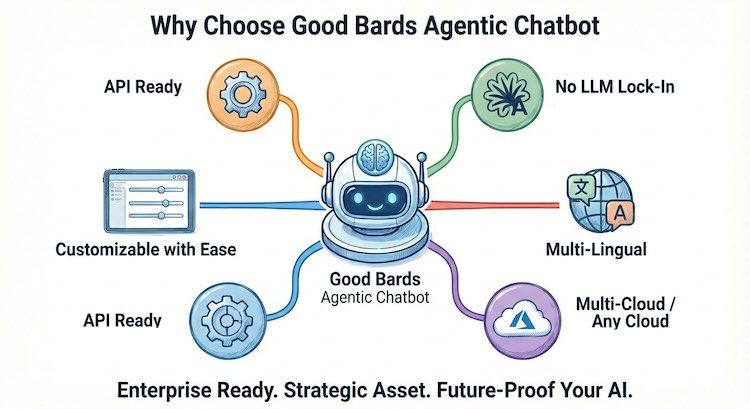
Before evaluating any vendor, CIOs should stress-test their chatbot platforms against five non-negotiable enterprise criteria:
API Readiness — Can it integrate with your existing enterprise ecosystem?
Customizable with Ease — Can prompts, context, and brand identity be configured without heavy technical overhead?
LLM Flexibility (No Lock-In) — Can you switch or combine AI models as the market evolves?
Multi-Lingual Capability — Does it serve linguistically diverse workforces and customer bases natively?
Multi-Cloud / Any-Cloud Deployment — Can it run on your infrastructure, in your region, on your terms?
Good Bards' platform was architected with these enterprise imperatives at its foundation — not as feature additions, but as core design principles.
Pillar 1: API Ready — Connecting to the Enterprise You Already Have
Modern enterprises run on integrations. ERP systems, CRM platforms, HR portals, data warehouses, ticketing systems — the average large enterprise operates hundreds of connected tools. A chatbot that cannot plug into this ecosystem is not a productivity multiplier; it is an island.
Good Bards' Agentic Chatbot is built API-first. Every function, workflow, and data retrieval the chatbot performs is accessible and orchestratable via well-documented RESTful APIs. This means:
IT teams retain control. APIs allow existing governance, security, and monitoring frameworks to wrap the chatbot's operations.
Integration without rip-and-replace. Whether your enterprise relies on SAP, Salesforce, ServiceNow, or custom-built internal tools, Good Bards connects through standard API protocols.
Automation at scale. Agentic workflows — where the chatbot takes multi-step autonomous actions — are triggered, monitored, and logged through the same API layer, enabling full audit trails that compliance teams require.
For CIOs who have watched previous technology investments fail due to integration friction, API readiness is not a nice-to-have. It is the foundation of enterprise adoption.
Pillar 2: Customizable with Ease — Built to Fit Your Enterprise, Not the Other Way Around
Most enterprise chatbot platforms treat customisation as an afterthought — a feature buried in a developer portal that requires specialist knowledge, lengthy implementation cycles, and vendor involvement every time the business needs to change something. For CIOs managing fast-moving organisations across multiple markets, that friction is a real operational cost.
Good Bards is designed for easy, business-led customisation at three levels that matter most to enterprise teams:
Prompt Configuration. Business teams can update the chatbot's instructions, tone, and behaviour without touching a single line of code. Whether the use case shifts from IT support to customer onboarding, or a new product line requires updated guidance, prompt changes are made through an intuitive interface — not a development sprint.
Context and Knowledge Management. Enterprises can feed the chatbot with the right context for each deployment — internal policies, product documentation, regulatory guidelines, or departmental knowledge bases. This context is manageable, updatable, and scoped precisely to what each chatbot instance needs to know, ensuring responses stay accurate and relevant as the business evolves.
Brand and Persona Alignment. The chatbot's voice, name, tone, and personality are fully configurable to match each enterprise's brand identity. A bank in Singapore and a retailer in Germany running on the same Good Bards platform will each present a chatbot that feels entirely their own — consistent with their brand standards, compliant with their communication guidelines, and appropriate for their customer base.
For CIOs overseeing deployments across multiple business units or geographies, this level of configurability means rolling out a new chatbot use case takes days, not months — and changing it takes hours, not weeks.
Pillar 3: No LLM Lock-In — Flexibility Across Regional LLMs and Global Models
The AI model landscape in 2025 and beyond is defined by rapid change. OpenAI, Google, Anthropic, Meta, Mistral, and a growing ecosystem of regional LLMs optimised for specific languages and geographies are all competing for enterprise adoption. Today's leading models — GPT-5.2, Claude Opus 4.6, Gemini 3.1 Pro, Llama 4, and Mistral Large 3 — are evolving at a pace that makes yesterday's top choice tomorrow's legacy decision. Betting your enterprise chatbot strategy on a single model means being locked into yesterday's choice tomorrow.
Good Bards' platform is LLM-agnostic by design. This means:
Run any model. GPT-5.2, Claude Opus 4.6, Gemini 3.1 Pro, Llama 4, Mistral Large 3, or regional models like SEA-LION (now at version 4, supporting 11 Southeast Asian languages with multimodal capabilities) or Qwen (optimised for Chinese) can be plugged into the Good Bards orchestration layer.
Mix models for different tasks. Use a cost-efficient model for routine queries, and a premium model for complex reasoning — all within the same chatbot interface.
Switch as the market evolves. When a better, cheaper, or more compliant model becomes available, CIOs can migrate without rebuilding the entire chatbot infrastructure.
This is particularly strategic for enterprises operating across Asia and Europe, where regional LLMs are increasingly preferred for regulatory compliance, data sovereignty, and linguistic accuracy. AI Singapore's SEA-LION programme — a government-backed LLM initiative — has demonstrated that regional models outperform general-purpose English-first models on Southeast Asian language tasks, and enterprises across the region are actively deploying them for customer service and business workflows. Good Bards gives enterprises the orchestration layer to leverage these models without being locked into any single provider's roadmap.
Pillar 4: Multi-Lingual — Built for Language-Diverse Regions
Asia is home to thousands of languages and hundreds of dialects. Europe operates across 24 official EU languages and more than 60 regional and minority languages. For enterprises operating across these geographies, a chatbot that speaks only English is not an enterprise solution — it is a pilot project.
Good Bards' Agentic Chatbot is built for genuine multi-lingual operation:
Natural Language Understanding (NLU) across languages. The platform is designed to comprehend intent, nuance, and context in languages including Mandarin, Bahasa Indonesia, Bahasa Malaysia, Thai, Vietnamese, Japanese, Korean, Tagalog, German, French, Spanish, Italian, Dutch, and more.
Dynamic language switching. Users can interact in their preferred language mid-conversation without the chatbot losing context or degrading in quality.
Regional LLM integration. By supporting regional LLMs optimised for specific linguistic contexts, Good Bards delivers accuracy that general-purpose English-first models cannot match for Asian and European enterprise users.
Consistent enterprise persona across languages. Brand voice, compliance messaging, and escalation protocols are preserved regardless of the language in which a conversation takes place.
For CIOs managing customer-facing operations, HR support functions, or internal IT helpdesks across multiple countries, multi-lingual capability is not optional — it is table stakes for enterprise readiness.
Pillar 5: Multi-Cloud, Any Cloud — Deploy Where You Need, Not Where Your Vendor Wants
Data sovereignty is no longer a theoretical concern. It is actively legislated. GDPR in Europe, the Personal Data Protection Act (PDPA) in Thailand, the Personal Data Protection Commission (PDPC) framework in Singapore, and a growing body of national data localisation laws across the region mean that where your data resides — and where your AI processes it — is a compliance question, not just a technical one.
Good Bards' Agentic Chatbot is built for multi-cloud and any-cloud deployment:
Deploy on AWS, Azure, Google Cloud, or private cloud. No infrastructure dependency means no forced migration and no vendor-imposed data routing.
On-premises deployment where required. For enterprises in highly regulated sectors — government, defence, financial services — Good Bards can be deployed entirely within private infrastructure, ensuring data never leaves the enterprise perimeter.
Hybrid architectures. Run inference on private cloud while leveraging public cloud for scalability during peak periods — all managed through a unified control plane.
Regional data residency. Deploy Good Bards in-region to satisfy local data localisation requirements without compromising chatbot capability or performance.
For CIOs navigating a complex patchwork of regional compliance requirements, any-cloud flexibility is the difference between a chatbot that scales globally and one that stalls at the border.
Why Agentic AI Changes the Enterprise Chatbot Equation
Traditional enterprise chatbots are reactive: they answer questions and route tickets. Good Bards' Agentic Chatbot is a different category of technology. It takes autonomous, multi-step actions on behalf of users — retrieving data from connected systems, executing processes, coordinating across departments, and completing workflows without requiring human hand-holding at every step.
The scale of the shift underway is significant. According to Gartner, 40% of enterprise applications will be integrated with task-specific AI agents by the end of 2026 — up from less than 5% in 2025. The agentic era is not a future state; it is the strategic window CIOs are navigating right now.
For enterprise CIOs, this distinction matters because:
Agentic AI drives measurable process efficiency, not just user satisfaction scores.
Complex enterprise workflows — procurement approvals, IT incident resolution, HR onboarding — can be partially or fully automated through a chatbot that can act, not just inform.
ROI is tangible and auditable, because agentic actions create logs, outputs, and measurable time savings.
Combined with Good Bards' enterprise-grade infrastructure — API ready, customizable, LLM-flexible, multi-lingual, any-cloud — the agentic layer transforms the chatbot from a support tool into a strategic operational asset.
Frequently Asked Questions
What is an enterprise ready chatbot?
An enterprise ready chatbot is a conversational AI platform designed to meet the security, compliance, integration, scalability, and governance requirements of large organisations. Key characteristics include API connectivity, ease of customisation, LLM flexibility, multi-lingual support, and multi-cloud deployment capability.
What does API ready mean for an enterprise chatbot?
API ready means the chatbot platform exposes all core functions through documented APIs, allowing integration with existing enterprise systems such as ERP, CRM, ITSM, and custom applications, without requiring proprietary middleware or vendor-specific connectors.
How easy is it to customise Good Bards' Agentic Chatbot?
Good Bards is designed for business-led customisation without heavy technical overhead. Prompts and chatbot behaviour can be updated through an intuitive interface, knowledge and context can be managed and refreshed as the business evolves, and the chatbot's brand voice, persona, and tone can be fully configured to match each enterprise's identity — all without requiring a development sprint for every change.
Why is LLM lock-in a risk for enterprises?
LLM lock-in means your enterprise chatbot is dependent on a single AI model provider. If that provider changes pricing, deprecates models, or cannot meet regional compliance requirements, your chatbot strategy is compromised. LLM-agnostic platforms like Good Bards allow enterprises to switch or combine models freely.
How does Good Bards support data sovereignty and compliance?
Good Bards supports any-cloud and on-premises deployment, enabling enterprises to run the chatbot within specific geographic regions or private infrastructure environments to comply with data localisation laws such as GDPR, PDPA in Thailand, PDPC in Singapore, and other national data residency regulations.
What regional LLMs can Good Bards integrate with?
Good Bards' LLM-agnostic architecture supports integration with regional AI models optimised for Asian and European languages. This includes AI Singapore's SEA-LION (version 4, supporting 11 Southeast Asian languages including Indonesian, Thai, Vietnamese, Malay, Filipino, Burmese, Lao, Tamil, Khmer, Chinese and English), Qwen for Chinese-language environments, and other regional and global models from major providers.
How does the EU AI Act affect enterprise chatbot deployments?
The EU AI Act, the world's first comprehensive AI regulatory framework, is being phased in with transparency obligations for general-purpose AI models effective August 2025 and high-risk AI system requirements taking effect from August 2026. Most enterprise chatbots fall under the "limited risk" category, requiring clear disclosure that users are interacting with AI. However, chatbots used in high-risk contexts — such as HR decision-making or financial services — face more stringent compliance obligations. Good Bards' configurable architecture and full audit trail capabilities provide the transparency and accountability that EU compliance demands.
The Good Bards Advantage: Built for Enterprise, Designed for the Future
Enterprise Requirement | Good Bards Capability |
System Integration | Full API-ready architecture |
Customisation | Prompts, context, and branding configurable without code |
AI Model Flexibility | LLM-agnostic, supports global and regional LLMs including SEA-LION v4 |
Language Coverage | Multi-lingual NLU across Asian and European languages |
Cloud Deployment | Multi-cloud, any-cloud, on-premises |
Workflow Automation | Agentic AI with full audit trail |
Regulatory Compliance | Data residency controls, configurable architecture, EU AI Act ready |
The CIO's Takeaway
The enterprise chatbot market is maturing fast. The platforms that will serve as long-term strategic assets are not the ones with the most impressive demos — they are the ones built on principles that enterprise technology leadership can trust: openness, flexibility, integration-readiness, and genuine linguistic and geographic scalability.
Good Bards' Agentic Chatbot is that platform.
For CIOs navigating the complexity of multi-regional enterprise operations across Asia and Europe, Good Bards offers what the market has largely failed to deliver: an enterprise ready chatbot that is truly ready — for your infrastructure, your languages, your compliance requirements, and your AI strategy, whatever form that strategy takes tomorrow.
Ready to evaluate Good Bards for your enterprise? Connect with our team to explore deployment options tailored to your region, infrastructure, and compliance requirements.


Comments